
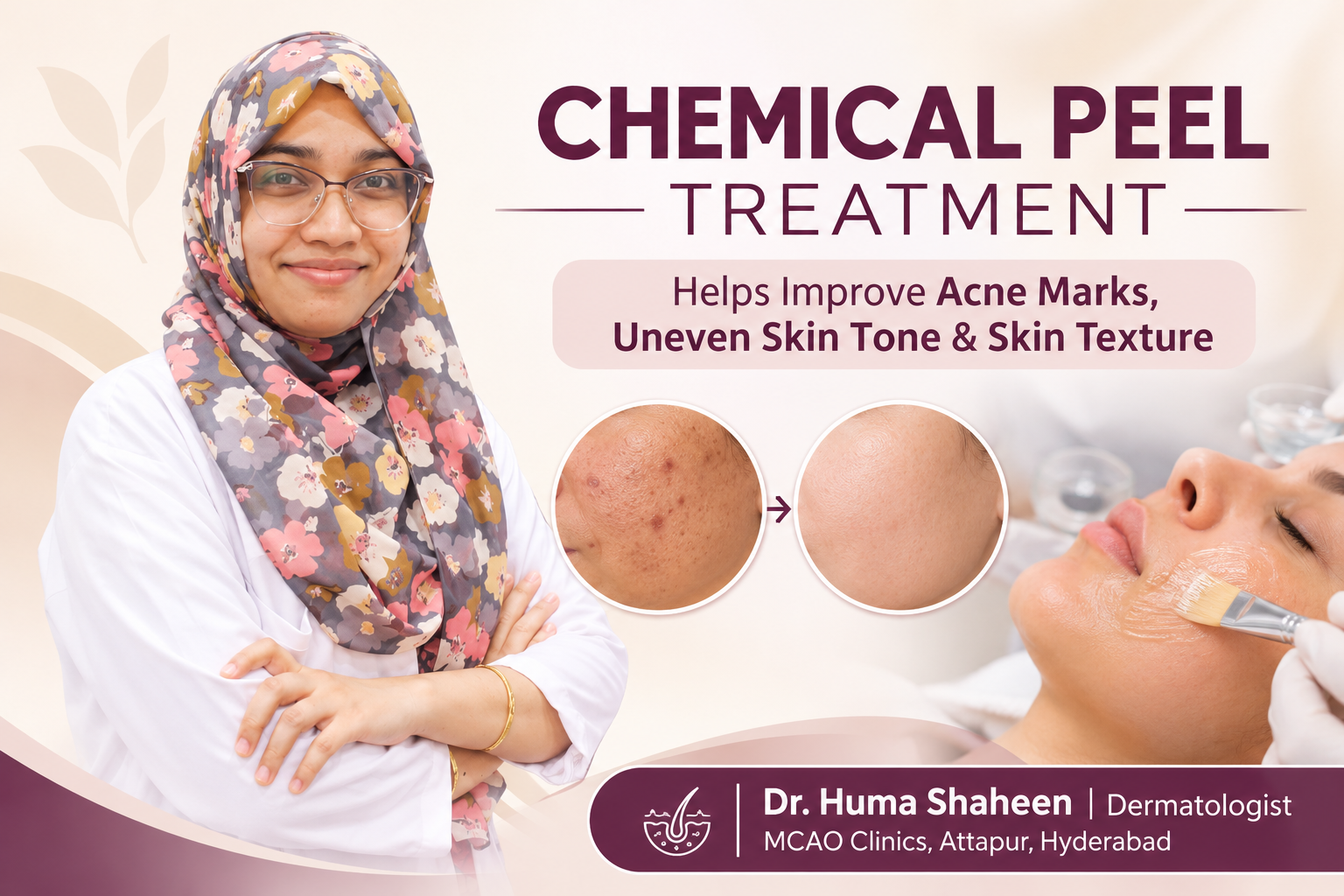

Chemical Peel Treatment in Attapur, Hyderabad: Benefits, Types, Cost and Recovery
Are you noticing acne marks, pigmentation, uneven skin tone or dull-looking skin? A chemical peel may be one option to improve certain skin concerns. Chemical peel treatment in Attapur, Hyderabad involves applying a dermatologist-selected solution to the skin to exfoliate its outer layers and support skin renewal. The right peel depends on your skin type, concern and medical history.
At MCAO Clinics, Attapur, chemical peel suitability should be assessed individually rather than choosing a peel based only on a trend or online recommendation.
What Is a Chemical Peel?
A chemical peel is a skin treatment in which a controlled chemical solution is applied to the skin. It removes or loosens selected layers of dead skin cells, encouraging the skin to renew itself.
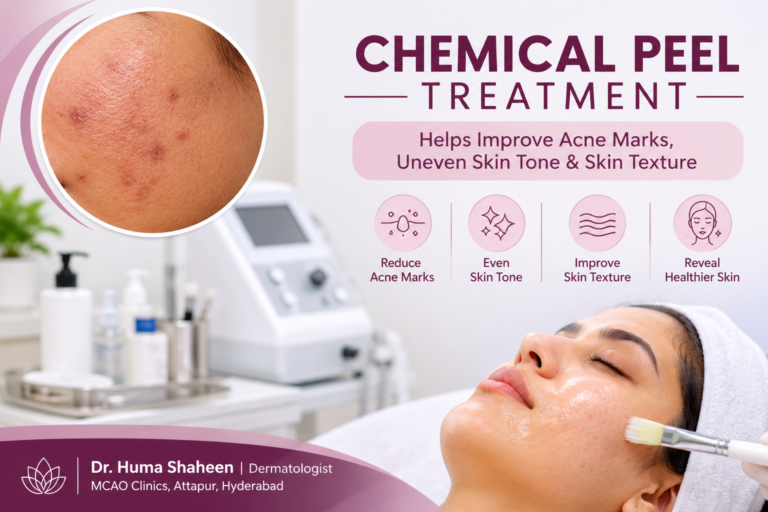
Depending on the formulation and strength, chemical peels may help with:
Certain types of acne and acne marks
Uneven skin tone
Some forms of pigmentation
Dull or rough skin texture
Fine lines and mild signs of sun damage
A peel does not treat every skin condition. For example, deeper acne scars and some types of melasma may need other treatments or a combination approach.
Who May Benefit from Chemical Peel Treatment?
A dermatologist may consider a chemical peel if you have:
1. Uneven skin tone
Some superficial peels can improve the appearance of uneven tone by removing pigmented surface cells.
2. Acne-prone skin
Certain peels may help manage selected forms of acne. Active acne should be assessed first so that the treatment plan addresses the underlying condition.
3. Pigmentation and dark spots
Some peels may improve selected types of pigmentation. However, pigmentation can have different causes, and the wrong peel may worsen dark patches, especially in darker skin tones.
4. Rough skin texture
A suitable peel may help improve mild roughness and make the skin feel smoother.
5. Fine lines and sun-related changes
Selected peels may improve the appearance of fine lines and some signs of sun damage. The extent of improvement depends on peel depth and individual skin characteristics.
Who May Not Be Suitable for a Chemical Peel?
A chemical peel may need to be postponed, modified or avoided if you have:
An active skin infection or open wounds in the treatment area
Significant skin irritation or inflammation
A recent sunburn or tan
A history of abnormal scarring or certain healing problems
A tendency to develop cold sores, depending on the treatment area and history
Certain medicines or skin treatments that affect healing
Pregnancy, breastfeeding and certain medical conditions may also affect treatment decisions. Always share your medical history and current skincare products with your dermatologist.
What Happens During a Chemical Peel?
Your treatment generally begins with a consultation and skin assessment.
-
Skin assessment: The dermatologist reviews your skin concern, skin type, medical history and current skincare routine.
-
Treatment selection: The type and strength of peel are selected according to your needs.
-
Skin preparation: The treatment area is cleansed. Some patients may need a pre-peel skincare routine.
-
Peel application: The solution is applied carefully for a controlled period.
-
Aftercare guidance: You receive instructions on moisturising, sun protection and products to avoid while your skin recovers.
Do not attempt to reproduce a clinic-strength peel at home. Strong chemical peels can cause burns, pigmentation changes and scarring if used incorrectly.
How Many Chemical Peel Sessions Are Needed?
The number of sessions depends on the peel type, skin concern and response to treatment. Some people may need a series of superficial peels, while others may need a different treatment altogether.
Your dermatologist will decide the interval between sessions. Repeating a peel too soon can irritate the skin and increase the risk of complications.
Recovery After a Chemical Peel
Recovery varies according to the depth of the peel.
After a superficial peel, you may notice mild redness, dryness or light peeling. Medium-depth peels can cause more visible redness, swelling and peeling and may require a longer recovery period. Deep peels involve significantly more healing time and specialist follow-up.
During recovery:
Use the moisturiser recommended by your dermatologist.
Apply broad-spectrum sunscreen as advised.
Avoid picking, rubbing or pulling peeling skin.
Avoid scrubs, exfoliating acids and retinoids until your dermatologist says they are safe to restart.
Avoid unapproved home remedies or strong skincare products.
Contact your clinic if you develop severe pain, blistering, increasing swelling or signs of infection.
Chemical Peel Treatment Cost in Attapur: What Affects the Price?
The cost of chemical peel treatment in Attapur can vary. It may depend on:
The type and strength of the peel
The size of the area being treated
The skin concern being addressed
Whether a series of sessions is recommended
Consultation and follow-up requirements
Any additional treatment included in the plan
A reliable cost estimate should be given after a skin assessment. Ask what is included in the quoted price and whether follow-up visits or skincare products are separate.
Why Choose a Dermatologist for Chemical Peels?
Chemical peels are medical skin procedures, not simply facial treatments. A dermatologist can identify the cause of pigmentation or acne, assess your skin type, choose an appropriate peel and explain the possible risks.
This is particularly important for Indian skin tones, where irritation or an unsuitable treatment can sometimes lead to post-inflammatory pigmentation.
At MCAO Clinics, Attapur, the focus should be on selecting treatment according to the skin concern, explaining realistic outcomes and guiding patients through aftercare.
Frequently Asked Questions
1. Is chemical peel treatment good for pigmentation?
Certain chemical peels may improve selected types of pigmentation. The cause of pigmentation must be identified first because melasma, post-acne marks and sunspots may need different treatment approaches.
2. Can a chemical peel remove acne scars?
Superficial peels may improve some mild surface irregularities and acne marks. Deep or indented acne scars usually need a different procedure or a combination of treatments.
3. How many sessions of chemical peel are needed?
Some people need multiple sessions, while others may not be suitable for a peel. The number and spacing depend on the peel strength, skin concern and response.
4. Does chemical peel treatment hurt?
You may feel temporary tingling, warmth, stinging or irritation during a peel. The sensation varies with the formulation and depth.
5. Can I go to work after a chemical peel?
Many people can return to routine activities after a superficial peel, although redness or peeling may be visible. Medium and deep peels can require more recovery time.
6. Is chemical peeling safe for Indian skin?
It can be suitable for some Indian skin types when the correct peel is selected and performed by an experienced dermatologist. An unsuitable peel can increase the risk of dark patches.
7. Can I use retinol after a chemical peel?
Do not restart retinol or exfoliating products until your dermatologist confirms that your skin has healed sufficiently.
8. Where can I get chemical peel treatment in Attapur, Hyderabad?
You can consult the dermatology team at MCAO Clinics, Attapur, Hyderabad, for an assessment of your skin concern and suitable treatment options.
Consult a Dermatologist in Attapur
If you are considering a chemical peel for pigmentation, acne marks, uneven skin tone or rough texture, begin with a dermatologist consultation. The aim is to choose a treatment that suits your skin, not simply the strongest available peel.
MCAO Clinics – Attapur, Hyderabad
Dr. Huma Shaheen, Chief Dermatologist

[…] Related reading: Chemical Peel Treatment in Attapur, Hyderabad. […]