
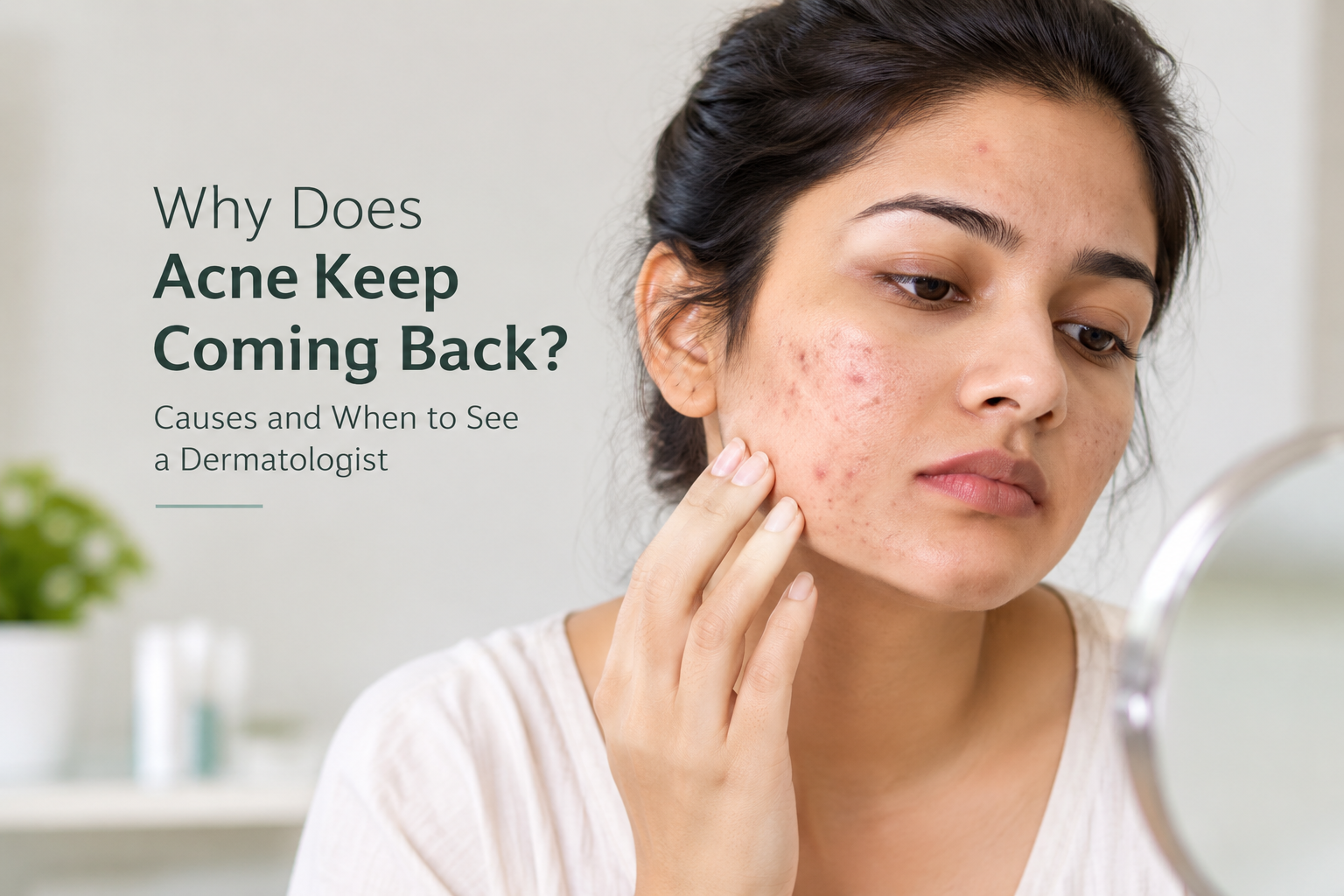

You treat your acne, it gets better for a while, and then a few weeks or months later, the breakouts start again.
If this sounds familiar, you may be wondering: why does my acne keep coming back even after treatment?
Recurring acne is common, but repeatedly treating individual pimples without understanding why they keep appearing can become frustrating. Acne can be influenced by hormones, oil production, clogged pores, skincare products, inflammation and several other factors. The right approach depends on what is causing your breakouts and what your skin looks like at the time of examination.
If your acne keeps returning, a consultation with a dermatologist can help you understand the pattern instead of simply trying another product.
Why does acne keep coming back?
Acne develops when hair follicles become clogged with oil and dead skin cells. Inflammation and changes in the skin’s natural oil production can then contribute to pimples, blackheads, whiteheads and deeper acne lesions.
But clearing a breakout does not necessarily mean that your tendency to develop acne has disappeared.
Some people continue to experience recurring acne because of hormonal changes, naturally oily skin, unsuitable skincare products, stress, certain medications or because treatment was stopped as soon as the skin looked better.
This is why recurring acne sometimes needs a longer-term treatment and maintenance approach rather than a quick fix.
Common reasons for recurring acne
Hormonal changes
Hormones can influence oil production and inflammation in the skin.
This is one reason acne may become more noticeable around menstruation or during periods of hormonal change. In some women, persistent acne around the jawline, chin or lower face may occur alongside other symptoms that warrant evaluation for an underlying hormonal problem.
Hormonal acne does not necessarily mean that hormones are the only cause, so a dermatologist can help determine whether further evaluation is appropriate.
Your pores may still be getting clogged
Even when visible pimples disappear, the tendency toward clogged pores can remain.
Excess oil, dead skin cells and certain skincare or cosmetic products may contribute to congestion. If new clogged pores continue forming, fresh breakouts can appear even after older acne has healed.
Your skincare routine may be irritating your skin
More skincare does not always mean better skin.
Frequent scrubbing, using too many active ingredients, repeatedly changing products or using products that are not suitable for acne-prone skin can irritate the skin barrier and make the situation harder to manage.
If your skin feels constantly dry, burning or irritated while you are treating acne, your routine may need to be reassessed.
Treatment was stopped too early
Acne can look much better before the tendency to develop new breakouts has completely settled.
Stopping treatment as soon as the skin improves can sometimes be followed by another flare-up. This does not mean that your previous treatment failed. It may mean that your skin needs a different maintenance plan.
Your dermatologist can tell you when it is appropriate to reduce or stop a treatment and what skincare routine to follow afterwards.
Picking or squeezing pimples
It can be tempting to squeeze a pimple when it becomes noticeable.
However, picking at acne can increase inflammation and may increase the risk of persistent marks and scars. If you find yourself repeatedly squeezing or picking your skin, treating the acne itself can make a bigger difference than simply trying to remove individual pimples.
Stress and lifestyle can play a role
Stress does not cause every case of acne, but changes in sleep, routine and stress levels may influence breakouts in some people.
Your skin can also be affected by the products you use, how consistently you follow treatment and other individual factors. Rather than blaming one food or one lifestyle habit for every breakout, it is more useful to look at the overall pattern.
Why does acne return after treatment?
One of the most common frustrations patients have is:
“My acne improved with treatment. Why has it come back?”
Acne is a condition that can recur, particularly when the underlying tendency remains.
For example, treatment may reduce inflammation and clear existing pimples, but your skin may still produce excess oil or develop clogged pores. Hormonal changes can also trigger new breakouts.
This is why acne treatment is not always about treating the pimple you can see today. A dermatologist may also focus on preventing new lesions from developing and reducing the risk of acne marks and scars.
Can your skincare products make acne worse?
Sometimes.
Heavy creams, certain makeup products, hair products that come into contact with the face, or products that do not suit your skin can contribute to congestion in some people.
At the same time, you do not need to stop moisturising simply because you have acne. Over-drying the skin can make your skincare routine more difficult to tolerate.
If you have acne-prone skin, a simple routine is often easier to maintain:
Gentle cleanser → appropriate treatment → moisturiser → sunscreen
The exact products and active ingredients should depend on your skin and the treatment prescribed.
When should you see a dermatologist for acne?
You do not have to wait until your acne becomes severe.
Consider seeing a dermatologist if:
- Your acne keeps returning despite trying different products.
- Breakouts are painful, deep or inflamed.
- Acne is leaving dark marks or scars.
- You are getting frequent breakouts as an adult.
- Acne is mainly appearing around the jawline or lower face and keeps recurring.
- Your acne is affecting your confidence or daily life.
- You are unsure which products or treatments are suitable for your skin.
- You have tried over-the-counter treatments without meaningful improvement.
A dermatologist can assess the type and severity of your acne and determine whether you need topical treatment, oral medication, procedures, lifestyle adjustments or a combination of approaches.
What does acne treatment involve?
There is no single acne treatment that works for everyone.
Treatment depends on the type of acne, how severe it is, whether you have marks or scars, your skin type, previous treatments and other individual factors.
Depending on the situation, a dermatologist may recommend:
- Prescription or non-prescription topical treatments
- Medicines to reduce inflammation and clogged pores
- Oral medication when appropriate
- Treatment for hormonal factors in selected patients
- Chemical peels or other procedures for suitable acne
- Treatment for acne marks after active acne is controlled
- Scar-focused treatments once the acne itself is under control
- A long-term skincare and maintenance routine
The important part is not choosing the longest list of treatments. It is choosing the treatment that actually fits your skin.
What about acne marks and acne scars?
Acne and acne scars are not the same thing.
A dark or red mark left after a pimple may gradually become less noticeable, while a true acne scar can involve a change in the skin’s texture.
If your acne keeps coming back, treating the active acne should usually come first. Once new breakouts are controlled, your dermatologist can assess whether additional treatment is appropriate for persistent marks or scars.
This is one reason it is better not to start aggressive scar treatments while active acne is still uncontrolled.
Looking for acne treatment in Hyderabad?
If you are searching for acne treatment in Hyderabad, it is worth looking beyond individual procedures and starting with a proper dermatology assessment.
For patients in and around Attapur, Upperpally and Rajendranagar, seeing a dermatologist locally can also make follow-up easier, especially when acne requires treatment over several months.
If you are looking for an acne dermatologist in Attapur, the consultation should focus on understanding why your acne keeps returning, what has already been tried and what your skin needs now.
Patients may also visit from other parts of Hyderabad, including Tolichowki and nearby areas, depending on their preferred location and treatment needs.
Can acne be completely cured?
Acne can often be controlled very well, but it is important to be realistic about the possibility of recurrence.
Some people experience acne only for a limited period, while others have recurring breakouts for years.
The aim of treatment is not simply to clear today’s pimples. It is also to reduce new breakouts, minimise inflammation and help prevent marks and scarring.
If your acne keeps returning, this does not necessarily mean that you have failed to find the “right product.” Your skin may simply need a proper assessment and a more structured treatment plan.
Frequently asked questions
Why does my acne keep coming back?
Recurring acne can be related to hormones, oil production, clogged pores, skincare products, inflammation and other individual factors. The cause is not always the same for everyone.
How can I stop acne from coming back?
The first step is identifying why the acne is recurring. A dermatologist can help create a treatment and maintenance routine suited to your skin rather than repeatedly treating individual breakouts.
Should I see a dermatologist for recurring acne?
Yes, particularly if acne is persistent, painful, leaving marks or scars, or not improving with basic skincare and over-the-counter products.
How long does acne treatment take?
It depends on the type and severity of acne and the treatment being used. Acne usually improves gradually rather than overnight, so consistency and follow-up are important.
Can acne cause permanent scars?
Inflamed or deeper acne can increase the risk of scarring, particularly when pimples are repeatedly picked or squeezed. Early treatment can help reduce the risk of long-term marks and scars.
Can a dermatologist treat adult acne?
Yes. Adult acne can be assessed and treated by a dermatologist. If there are signs suggesting a hormonal or other underlying factor, the dermatologist may recommend additional evaluation.
Acne care at MCAO Clinics
At Maple Clinical Aesthetics & Obesity Clinic, acne concerns are assessed as part of dermatology care rather than treating every breakout with the same procedure.
Dr. Huma Shaheen evaluates the type of acne, the condition of the skin, previous treatments and whether there are concerns such as pigmentation or scarring before recommending a treatment approach.
If your acne keeps coming back despite trying different products, a consultation can help you understand what may be driving the breakouts and what can be done to control them.
Attapur:
2-4-79/1, Pillar No. 180, 1st Floor, Rahmat’s Iconiq square, Attapur, Rajendranagar, Upperpally, Hyderabad, Telangana 500048
Tolichowki:
8-1-400/48/A, near Galaxy Theater, Galaxy, Deluxe Colony, Janaki Nagar Colony, Toli Chowki, Hyderabad, Telangana 500008

[…] If your acne repeatedly returns, read our related guide: Why Does Acne Keep Coming Back? […]